

On this page
- Who This Article Is For (and Who It Is Not For)
- What AFUE Actually Measures (and What It Doesn’t)
- How AFUE Ratings Are Calculated
- Understanding Efficiency Tiers: 80% vs 90% vs 95% and Up
- What a “Good” AFUE Rating Means in Canada
- Why Efficiency Matters More in a Timmins Winter
- Turning AFUE Percentages into Real Bill Savings
- Features That Push AFUE Higher
- How to Find Your Furnace’s AFUE Rating
- AFUE vs Real-World Performance
- When a High-Efficiency Upgrade Makes the Most Sense
- AFUE and Heat Pumps
- Common Mistakes to Avoid
- Your Next Steps
For all your heating and cooling needs.
Call dispatch at (705) 221-0677 or request service.
When you start shopping for a new furnace, one number shows up on almost every spec sheet: the AFUE rating. It is usually shown as a percentage, like 80% or 95%, and most product labels do not bother to explain what it actually means for your home. If you have ever looked at those numbers and wondered how they connect to the gas bill you pay every winter, you are in the right place.
In this article, we break down what AFUE really measures, how it is calculated, and what a “good” rating means when you heat a home through a Northern Ontario winter. We will also show you a simple way to estimate your own savings and explain why the rating on the box is only part of the story.
Who This Article Is For (and Who It Is Not For)
This is written for homeowners in Timmins and nearby communities like South Porcupine, Schumacher, Cochrane, Kapuskasing, Kirkland Lake, Hearst, and Smooth Rock Falls who want to understand furnace efficiency before they buy or replace a heating system.
This article is for you if:
- You are researching a new furnace or boiler and keep running into AFUE percentages.
- You want to know how efficiency affects your winter heating bills.
- You have an older furnace and are wondering whether an upgrade is worth it.
This article is probably not for you if:
- You need help choosing the right furnace size. That is a separate topic, and you can check our furnace sizing guide.
- You are looking for brand-by-brand model comparisons or financing details.
- You want a step-by-step installation walkthrough.
We are keeping the focus narrow on purpose: by the end, you should understand what AFUE means and feel confident reading those numbers yourself.
What AFUE Actually Measures (and What It Doesn’t)
AFUE stands for Annual Fuel Utilization Efficiency. It tells you what percentage of the fuel your furnace burns actually turns into usable heat for your home over a whole heating season. The rest is lost, mostly up the exhaust vent.
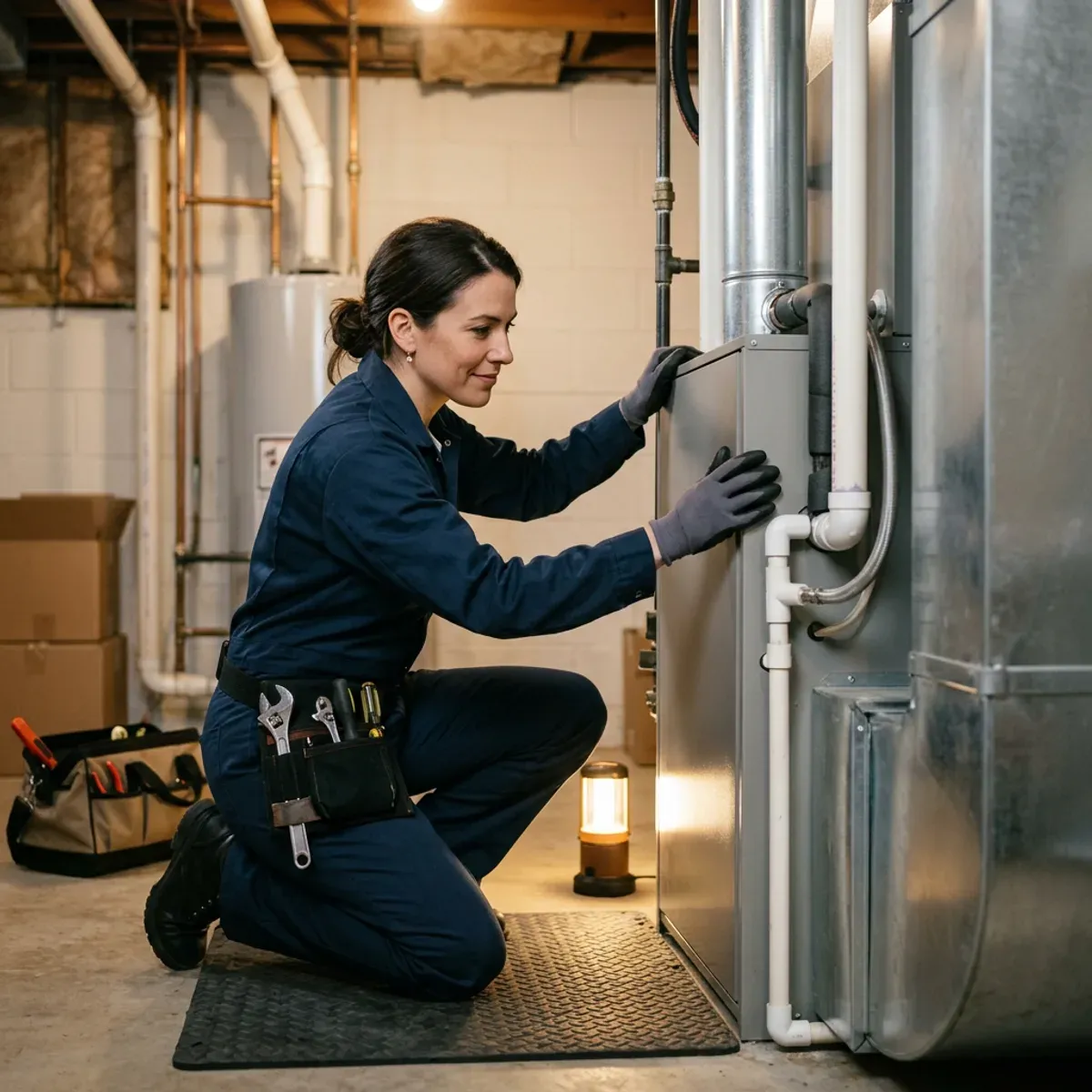
A common way to picture this is fuel economy in a car. Miles per gallon tells you how far you go on a tank. AFUE tells you how much of your fuel bill becomes heat in your living room.
Here is the simple version:
- An 80% AFUE furnace turns about 80% of the fuel into heat. The other 20% is lost.
- A 95% AFUE furnace turns about 95% of the fuel into heat, with only 5% lost.
So far, so good. But here is the part many sellers skip. AFUE does not measure everything about how efficiently your home is heated. According to Natural Resources Canada, AFUE is a seasonal measure of fuel efficiency only, and it does not include the electricity used to run controls, fans, or pumps.
AFUE does not account for:
- Heat lost through leaky or uninsulated ductwork.
- The electricity your blower motor uses.
- How your thermostat is set or programmed.
- Air leaks in your home itself.
We point this out because it matters. A high-AFUE furnace on a leaky duct system can still waste heat and leave you with higher bills than the sticker promised. The rating describes the equipment, not your whole house.
How AFUE Ratings Are Calculated
The basic formula is straightforward:
AFUE = (Annual Heat Output ÷ Annual Fuel Input) × 100
To keep ratings fair across manufacturers, the test uses a standardized amount of fuel input over a heating season and measures how much of it becomes usable heat. BTU stands for British Thermal Unit, which is just a unit of heat energy.
Here is a worked example:
- Start with 100 million BTUs of fuel going into the furnace.
- Measure how much usable heat comes out.
- If the furnace produces 95 million BTUs of heat, divide 95 by 100 and multiply by 100.
- That gives you a 95% AFUE rating.
The “lost” 5% goes out with the exhaust gases. In older furnaces, those hot gases carry a lot of energy up the chimney. The whole point of a high-efficiency design is to grab as much of that heat as possible before it escapes.
In Canada, federal furnace rules reference the CSA P.2 standard for AFUE testing. The product class and fuel type determine the exact test requirements, which is why you can trust that a 95% rating from one brand means the same thing as a 95% rating from another.
Understanding Efficiency Tiers: 80% vs 90% vs 95% and Up
Furnaces generally fall into three groups. The percentages below are commonly used across the industry, though exact ranges can vary slightly by source.
Standard Efficiency (around 80% to 83%)
These are non-condensing furnaces. They burn fuel, pull heat through one heat exchanger, and vent the leftover hot gases out a chimney or metal vent. They work, but a meaningful chunk of energy leaves as exhaust. Most older Timmins homes, especially those built before the mid-2000s, have a furnace in this range.
High Efficiency (roughly 90% and up)
These are condensing furnaces. The name comes from how they work. A second heat exchanger pulls extra heat out of the exhaust gases, cooling them enough that water vapour condenses into liquid. That recovered heat is what pushes efficiency into the mid-90s.
Premium High Efficiency (around 96% to 98.5%)
Top-tier condensing furnaces use refined heat exchangers and smart controls to squeeze out a few more points of efficiency.
What a “Good” AFUE Rating Means in Canada
Here is something important for anyone shopping today. In Canada, federal regulations set a 95% AFUE minimum for a defined class of residential gas furnaces. As of October 2026, this applies to gas furnaces manufactured on or after July 3, 2019 that are non-relocatable, single-phase, rated at no more than 225,000 BTU/h, and without integrated cooling. Other classes of gas furnace have different minimums, including 78%, 80%, and 90% AFUE.
There are specific variants for certain equipment classes:
- 78% AFUE for outdoor furnaces with integrated cooling.
- 90% AFUE for space-constrained furnaces with integrated cooling.
- 80% AFUE for relocatable-building furnaces and replacement non-condensing furnaces.
You can read the details directly in the Natural Resources Canada furnace efficiency standards.
What this means in plain terms: if you are replacing a standard gas furnace in Timmins today, your practical options are almost all in the 95% to 98.5% range. The old 80% models are no longer the default choice for most homes. So the real question is usually not “80 vs 95,” but whether to keep nursing an aging 80% unit or replace it with a modern 95%-plus one.
Why Efficiency Matters More in a Timmins Winter
In our part of Northern Ontario, the heating season runs long. Most of us run our furnaces from October right through to April, and sometimes into May. During deep cold snaps, the furnace may run close to full tilt for days at a time.

That long run time is exactly why efficiency pays off here more than in milder places. A small efficiency difference, multiplied across thousands of heating hours, adds up. A furnace that wastes 20% of its fuel will cost noticeably more to run over a Timmins winter than one that wastes only 5%.
The savings percentage from a higher AFUE stays the same no matter what gas prices do. That makes high efficiency a kind of long-term hedge: you are using less fuel for the same comfort, year after year, regardless of where rates land.
Turning AFUE Percentages into Real Bill Savings
Let us put some numbers on this. The relationship is simple: for the same amount of heat your home needs, the fuel you must buy goes down as AFUE goes up.
The savings fraction when you move from an old furnace to a new one is:
1 − (old AFUE ÷ new AFUE)
For a move from 80% to 95%:
- 1 − (0.80 ÷ 0.95) = about 0.158
- That is roughly 15.8% less fuel for the same comfort.
A Worked Timmins Example
Say a home needs 100 million BTUs of actual heat over the season. Here is how two furnaces compare, using an approximate 35,000 BTU per cubic metre for natural gas.
| Item | 80% AFUE | 95% AFUE |
|---|---|---|
| Heat needed | 100,000,000 BTU | 100,000,000 BTU |
| Fuel input required | 125,000,000 BTU | about 105,263,000 BTU |
| Gas volume | about 3,571 m³ | about 3,007 m³ |
| Fuel used saved | , | about 564 m³ |
Now for the dollars. Timmins sits in Enbridge Gas’s Union North East rate zone. Effective October 1 through December 31, 2026, the OEB-listed Union North East gas-supply rate is 17.7762¢/m³, made up of a 15.6674¢/m³ gas-supply charge and a 2.1088¢/m³ quarterly adjustment.
Using roughly that supply rate, about 18 cents per cubic metre:
- 80% furnace gas supply cost: about $643
- 95% furnace gas supply cost: about $541
- Seasonal savings: about $102
For a bigger or less insulated home that uses more gas, the dollar savings scale up. Over the 15 to 20 year life of a furnace, those seasonal savings add up to real money. If you want a deeper look at the full cost picture, we cover it in are high-efficiency furnaces worth the investment.
Features That Push AFUE Higher
Several technologies help modern furnaces reach those high ratings. They also tend to make the furnace quieter and more comfortable to live with.
- Secondary heat exchangers pull heat from the exhaust gases that older furnaces throw away.
- Sealed combustion draws outside air for burning instead of using your heated indoor air.
- Electronic ignition replaces the old standing pilot light, which burned gas even when you did not need heat.
- Modulating gas valves adjust the flame to match how much heat the house actually needs.
- Variable-speed ECM blowers move air more efficiently and use less electricity than older single-speed motors.
Keep in mind that AFUE does not capture the electrical savings from an ECM blower. Those show up on the electricity side of your bill, not the gas side. So a high-efficiency furnace can save you in two places at once, even though the AFUE number only tells part of that story.
How to Find Your Furnace’s AFUE Rating
Finding your current rating is usually quick.
- Check the furnace cabinet. Look for an EnerGuide label, often near the data plate or the electrical disconnect. As of October 2026, NRCan’s EnerGuide label for furnaces is voluntary. It shows the model type, the AFUE, and a pointer showing where that model sits compared to similar units. A higher rating means greater efficiency.
- Check the owner’s manual if the label is missing or worn.
- Look up the model number online on the manufacturer’s site.
For much older furnaces with no label at all, a good rule of thumb is that pre-2000 units often fall in the 80% range or lower. If you are not sure, an experienced technician can usually identify the technology type and give you a solid estimate.
One note to avoid confusion: the standard appliance EnerGuide label that shows annual kWh is a different format. It is mandatory only for products covered by those specific labeling rules, so do not expect that exact sticker on your furnace.
AFUE vs Real-World Performance
This is where honest advice matters. The AFUE on the box is tested in a lab under standard conditions. Your actual results depend on your whole heating system.
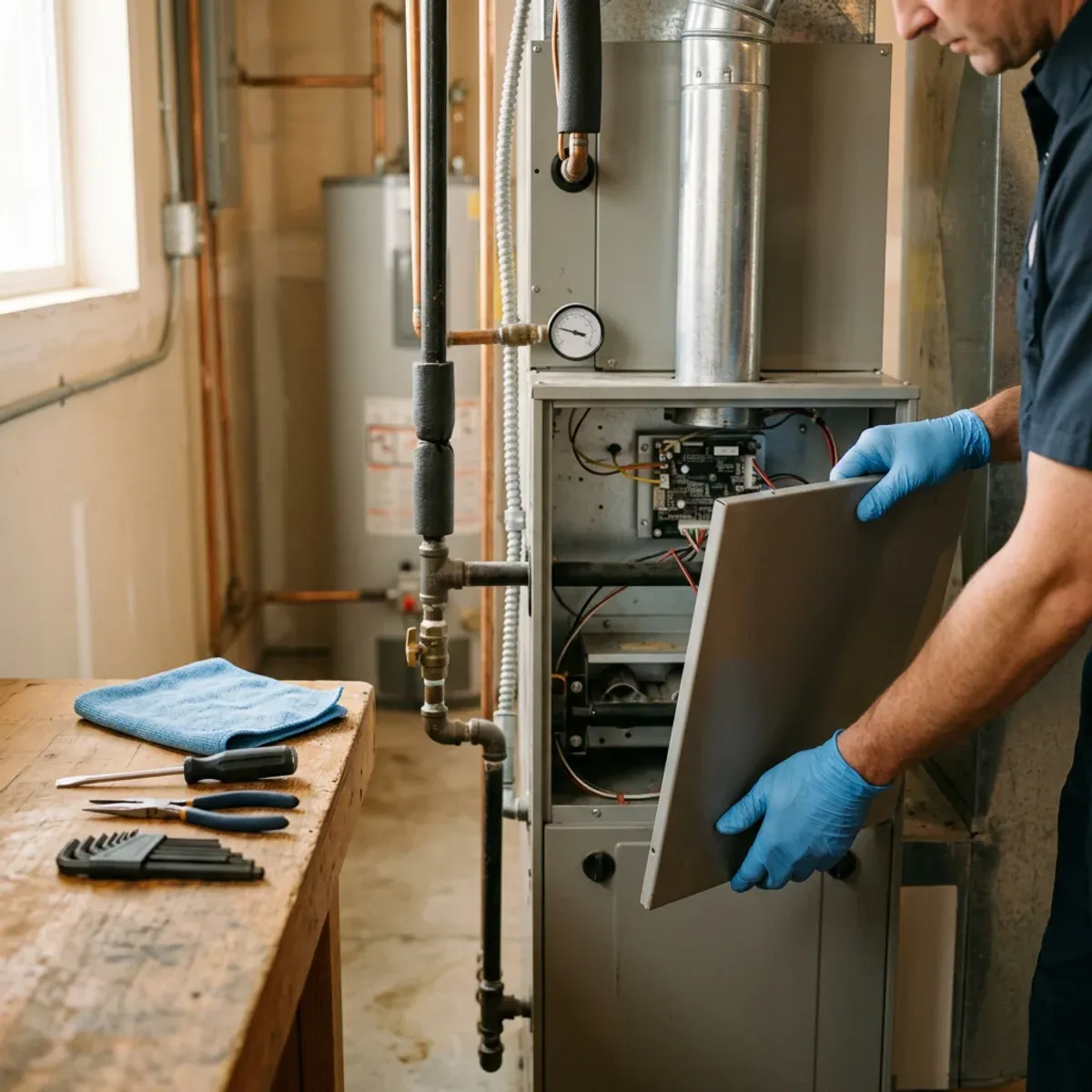
Things that quietly lower your real-world efficiency:
- Leaky or uninsulated ductwork running through cold basements, crawlspaces, or attics.
- A furnace that is oversized or undersized for the home.
- Skipped maintenance that lets the system run dirty or out of tune.
- Poor thermostat placement or settings.
- Air leaks and weak insulation in the house itself.
Here is the cause and effect in simple terms: a top-rated furnace bolted onto a leaky duct system will still lose heat into spaces you are not trying to warm. That makes it run longer and burn more fuel than its rating suggests. The equipment is only as good as the install and the home around it.
This is also a good time to book a tune-up before winter. Regular maintenance keeps a furnace running close to its rated efficiency. If you want to ask about seasonal maintenance, we are happy to walk you through it.
When a High-Efficiency Upgrade Makes the Most Sense
Since 95% is now the standard for most new gas furnaces, the main decision for most homeowners is timing, not efficiency tier. Here is what to weigh.
A new high-efficiency furnace usually makes strong sense when:
- Your current furnace is 15 to 20 years old or starting to fail.
- You plan to stay in the home long enough to collect the fuel savings.
- You are heating a larger or less-insulated home with high gas use.
- You are already doing related work, like duct or insulation upgrades.
Replacing can wait, within reason, when:
- Your existing furnace is newer and running well.
- A simple repair will reliably get you through more seasons.
We will be straight with you: chasing the last couple of AFUE points from 95% to 98% does not always pay back in a small, well-insulated home. In a big, heat-hungry house, it might. The right answer depends on your fuel use and how long you will stay.
AFUE and Heat Pumps
Many Timmins homeowners are also asking about cold-climate heat pumps. Heat pumps are rated with different numbers, like HSPF2 and SEER2, not AFUE. When you compare efficiency with the newer test standards, note that the newer standard produces slightly lower numbers for the same unit, so do not treat the old and new figures as interchangeable.
In many homes here, the practical setup is a heat pump paired with a high-efficiency furnace as backup for the deepest cold. In that case, AFUE still matters, because it decides how efficiently your backup gas heat runs when the mercury drops. If you are weighing your options, our heat pump vs furnace comparison and the Heat pump heating guide are good next reads.
Common Mistakes to Avoid
- Treating AFUE as your whole bill. It covers fuel efficiency only, not electricity or duct losses.
- Assuming a high rating fixes a leaky home. It does not. The house matters as much as the furnace.
- Comparing old and new efficiency numbers directly when heat pumps are involved.
- Skipping the install details. Condensing furnaces need proper venting and condensate drainage to hit their rating.
- Ignoring maintenance. A dirty, neglected furnace drifts below its rated efficiency over time.
Your Next Steps
Here is a simple plan to put this to use:
- Find the AFUE on your current furnace using the label, manual, or model number.
- Note roughly how much gas you use in a winter from past bills.
- Use the savings formula to estimate what a newer, higher-AFUE unit could save you.
- Factor in your furnace’s age, your home’s insulation, and how long you plan to stay.
If you want a second set of eyes, we are glad to look at your current system, explain your options in plain terms, and give you honest upfront pricing before any work starts. You can also learn more about our furnace installation work.
AFUE is one of the clearest, most honest numbers in the heating world. Once you understand it, those spec sheets stop being confusing and start being useful.
For all your heating and cooling needs, (705) 221-0677.
Mike Ironclad
